Jupiter in ‘Kumbha’ & Vishu 2021

In Indian astrology, Jupiter holds prominence over all the planets, not only because he is generally a benefactor, but also because he is regarded as the Guru or Teacher and is known to impart knowledge and wisdom. Jupiter moves slowly along the Zodiac, and progresses by one sign each year. This year Jupiter makes a move to the sign of Aquarius temporarily in April where he will remain for a few months. Jupiter’s transit to the sign of Aquarius has great astrological importance in India.

Aquarius, or ‘Kumbha’ represents the pot. The pot is a carrier of water. In Indian mythology when the Samudhra Manthan was done, the Goddess brought forth the Amrita or ‘nectar of immortality’ in a pot (Kumbha). Thus Kumbha is of particular significance and variously represents the carrier of nectar, water or of other important things for the benefit of mankind. Thus when the planet of wisdom, Jupiter, moves into Kumbha, it is given importance since it implies that this pot of knowledge is available to those who are seekers. Thus also the myth, that when Jupiter moved into Aquarius, the nectar spilled from the pot into different places in India.

The Kumbha Mela is held once every 12 years, each time when Jupiter moves into Aquarius and the Sun is exalted in Aries. Sun represents the soul, so when the Sun is in Aries and exalted, and Jupiter is in Kumbha, the soul is fully open to receive the knowledge and get enlightened. The Kumbha Mela historically was an occasion when the Kings would meet his subjects and donate gifts and valuables. It was also an occasion when people would gather at the Ganges to wash away the sins and start afresh on spiritual learning and enlightenment.

Happy Vishu!!

Jupiter has already crossed over to Aquarius during April, while Sun moves into Aries on the Vishu day (Tamil New Year). Thus, this year’s Vishu is special. The Sun shines in Aries and the Jupiter transits to Aquarius. Inline with our tradition, lets wash away our past sins, all our troubles and start afresh on a journey and quest for spiritual knowledge and wisdom.

Vatapi Ganapati – The Place, Story and the Significance

We begin the year with the first Sankatahara Chaturthi of 2021. It is thus relevant to recall the legend associated with the place and the significance of the Ganesha idol of Vatapi.

Vatapi is a place in Karnataka and the capital of the kingdom of the Chalukyas. The place derives its name from the story of the asura having the same name (Read: The Story of Vatapi).

A Ganapati temple was soon after established here and the idol that originated from this place, is referred to as Vatapi Ganapati and is said to have been once worshipped by Sage Agastya, the slayer of the demon, Vatapi.

In the latter years, the region around Vatapi was ruled by the Chalukya dynasty and the Ganesha deity gained prominence thereafter as a remover of obstacles & bestower of boons. It is believed that this Ganesha idol was subsequently brought to the temples of Tamil Nadu from Vatapi after a conquest of the Chalukya kingdom. The idol now resides in a temple in Nagapattanam, Tamil Nadu.

This particular idol of the elephant headed God has four hands, holding a sugar-cane in one of his hands, and a broken tooth in another (with which he slayed Gajamukhasura) among other objects. The  lord in this form is known as a remover of obstacles & is revered by both Agastya and Lord Vishnu.

It is said that the legendary Sri Muthuswamy Deekshitar was so enamoured by the idol and composed a song in the praise of the Lord Ganapati of Vatapi. The song bears the reference – “Vatapi Ganapatim Bhaje”, which literally means, I pray to the Lord Ganapati of Vatapi. The song is one of Muthuswamy Dikshitar’s most prominent compositions and is very frequently sung at Carnatic music performances.

With this first Sankatahara Chaturthi of the year, we hope and pray the year 2021 is the year when all the obstacles facing us are removed and we have a peaceful and healthy year ahead.

HAPPY NEW YEAR, 2021!

Vaikuntha Ekadasi – A day of Fasting & Prayers

It is said that on the day of Vaikuntha Ekadasi, the doors of Vaikuntha (Vishnu’s abode) is thrown open. In other words heaven is open for the common man. There are many stories associated with Vaikuntha Ekadasi. In general, Ekadasi in any month, is considered as a time for contemplation, prayers and fasting. What is the reason behind this tradition of observing fast and quietude on this particular day?

Of course its hard to pin point one reason behind this age old tradition. However, one may notice that an Ekadasi day is always partly ruled by ‘Vishti’ Karana. A Karana is one of the five components of the Hindu Panchanga and is taken as half of a ‘Thithi’ (in simpler terms, one half of a day).

Vishti Karana is ruled by Yama (& the planet Saturn) and is considered poisonous and malefic in terms of any deeds undertaken on this day. Since every Ekadasi has Vishti Karana, doesn’t it make sense that you fast on this day. You also digress into prayers to avoid doing any major tasks this day. This is just a thought and possibly one among a plethora of reasons behind the traditions of Ekadasi.

An Insight into the Science taught by the Vedas

Science is the study of the world outside,
Philosophy is the study of the world within!

Swami Chinmayananda

The human race has forever been in a quest to understand the cause behind all creation. This quest to unravel the mystery of creation has in effect led to our exhaustive study of our universe, all living beings and the laws that govern it. We understand this exhaustive study as ‘Science”. Science has in turn diversified into various branches; from Biology, Chemistry, Physics to Geography, Cosmology, Medicine and so on. We have invested a lot in the deeper understanding of the outside world hoping that we can someday unravel the mystery and cause of all creation.

meditation, spiritual, yoga

However, the ancient books of the Vedas have a different view. The ancient Rishis however realised that the mystery cannot be solved by conventional methods of study and research. They understood that the ‘Truth’ is within and the way to realise this truth, the existential reality is to turn our focus inwards.

Thus most of the Vedas teach a path of contemplation and meditation as the practical way to turn our thoughts inwards, within us and realise the ‘consciousness’. This ‘consciousness’ is what the Vedas and the Upanishads teach is the Supreme reality and the cause behind all creation.

This is the difference today between what we study as conventional knowledge of the material world through various subjects. The Vedic knowledge on the other hand is unique and is probably the only available literature to direct our thoughts towards realising our ‘CONSCIOUSNESS’, the truth within ourselves. Even the study of the mind or psychology is in reality only an understanding of our superficial thoughts and worries and doesn’t really delve into the deeper realms within ourselves.

While we should be proud of the richness of this unique literary wealth we treasure, the Vedic knowledge should also be studied & appreciated by our generation.


Celebrating Guru Poornima

As we celebrate Guru Poornima, it would be nice to understand the Astrological significance behind the day. Jupiter is widely regarded as the Guru of the Devas and being the Teacher for all, He is the one responsible imparting traditional knowledge and showing the path of righteousness to one and all. Jupiter owns the houses of Sagittarius and Pisces (read the article on Horoscope Basics). Sagittarius is also the 9th house from Aries, the beginning of the natural zodiac, and stands for Guru or the Teacher. Being the 9th house and being owned by Jupiter, the teacher himself, the sign of Sagittarius holds a lot of significance when it comes to one’s Teacher and receiving wisdom & knowledge from him.

Guru Poornima is celebrated during the months of July / August on a Poornima day (read the article: Celebrating Pournami), when the Full Moon is in Sagittarius & the Sun in Gemini. The Moon represents one’s mind and a therefore a full moon in the sign of Sagittarius would mean the mind is fully open and receptive to the teachings and wisdom from one’s Teacher due to the facts we explained earlier.

While the full Moon in Sagittarius is celebrated as Guru Poornima, 2020 is unique. This is because Jupiter himself is also currently in the sign of Sagitarrius along with the Full Moon making it even more auspicious. Here the Teacher himself is closely associated to the mind.

The lockdown presents a golden opportunity to utilize one’s time in learning new skills and wisdom and what can be better day to start than this Guru Poornima!

Keep Learning and importantly lets seek blessings from our Gurus!

Covid-19 & an Astrological Analysis

We have scores of theories on the astrology behind the Covid-19 pandemic and a multitude of opinions that relate the positions of the planets to the global calamity. And much has been written about the conjunction of Jupiter, Saturn and Ketu in the sign of Sagittarius. This conjunction is no doubt a significant event and Ketu being in its own Nakshatra of Moola, does badly afflict Jupiter. On the other hand, an exalted Rahu casts its aspect from the sign of Gemini. Jupiter is thus cornered by a combination of Saturn, Ketu in the sign of Sagittarius and Rahu aspecting from Gemini. Jupiter is a priestly graha and easily succumbs to this malefic combination as what we see in the world today.

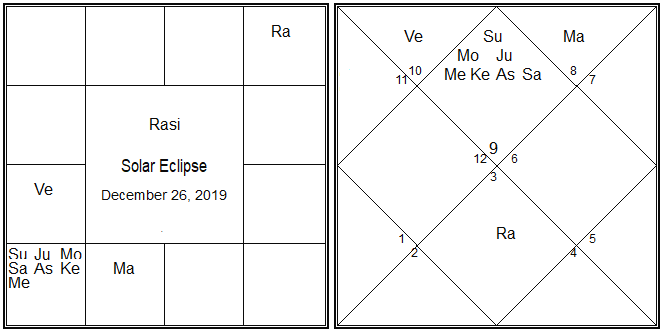
However, what is also missed is a peculiar event that seems to have triggered the pandemic. The roots of the current pandemic seem to lie in a very unique and rare event that occurred on 26th December, 2019. As we can see in the astrological chart cast for the December 26th 2019 we have six grahas, all of them ensconced in the sign of Sagittarius, viz. Jupiter, Saturn, Ketu, Sun, Moon and Mercury.

This is undoubtedly a rare celestial incidence. To add to this, Dec 26th also was the day of a solar eclipse. Too many rare incidences to occur on the single day. In all probability, this is the trigger behind the global worries and the Ju-Sa-Ke-Ra combination only worsens the issues. Incidentally, the pandemic also began around this time in Wuhan, China.

It cannot be ascertained accurately when such a unique position occurred in the past. A rough, back of the envelope calculation indicates that such a combination would have probably occurred about 60 years ago, around the time of the World War II. That does say a great deal of the sheer magnitude of this malefic combination and how it impacts the world harmony.

Later this year, by September Rahu-Ketu will transit backwards into Taurus & Scorpio respectively, thus breaking the chain. Jupiter will continue to be with Saturn as it will transit into Capricorn and will be debilitated. Nonetheless, it will still not be a very comfortable situation for the world harmony, but the Ra-Ke transit may break the chain of events into a more progressively peaceful one.

Let us all hope and pray for global peace in these months to come…

Meshadi & The New Year (Vishu)

Aries (Mesha Rasi) is said to be the first among the Rasis (Zodiac Signs) and the entry of the Sun in Mesha signifies the beginning of a New Samvatsara (a fresh cycle of the revolution of the Sun). Also, Aries is the point of exaltation of the Sun (according to Indian Astrology) and holds significance.

For these reasons, the Sun’s entry into Mesha signifies the start of the Tamil / Malayalam New Year.

Mesha (Aries) + Aadi (Beginning); implies the crossing over of the Sun into the beginning of Mesha which typically occurs in the mid of April.

April 14th 2020 will be celebrated as The New Year or Vishu in South India. We enter into Shaarvari Samvatsara this New Year

The Vishu Konna flowers (in the photo) are yellow colored flowers that typically bloom around this year and is considered auspicious and on display for the Vishu Kanni.

The Indian culture has several calendar systems. With The Lunar calendar system, every Pournima or in some cases, Amavasya, marks a new month. However in the South, the Solar calendars are prevalant and here a new month begins whenever the Sun crosses into the next Zodiac Sign & the Sun crossing into Aries indicating a new year.

BEST WISHES FOR THIS VISHU!!

Covid-19 and the relevance of The Bhagavad Gita in the Current Challenges

देवान᳭ भावयतानेन ते देवा भावयन्तु व:।

परस्परं भावयन्त: श्रेय: परमवाप्स्यथ॥११॥

Bhagavad Gita Chapter: 3, Verse 11

These lines are from the 3rd Chapter (Karma Yoga) of the Bhagavad Geeta and very aptly summarises the current challenges that the human race is facing today from Nature.

The word, ‘Deva’, here refers to the forces of nature (& not literally God). The above verse means:

If we, (humans) respect nature, then these forces of nature upon which we have virtually no control, shall respect us back. Thus honoring & respecting each other, we together shall grow and prosper.

Translation of the Gita

Man through his greed seeks to control and consume everything around him, thereby affecting himself in the long run. In this context, the word ‘respect’ means to cherish, and protect thereby, we mutually grow and prosper together.

On the other hand, when we consume and destroy nature, it reciprocates in a similar manner albeit in unknown & unforeseen ways. This is exactly what we are witnessing in the world today.

Thus “Preserve and Protect for Mutual Growth” is what The Bhagavad Gita teaches us and is very pertinent even in today’s World!

Take Care and Be Safe!!